

Key Takeaways
- Site-specific structured cabling supports phones, Wi-Fi, cameras, servers, and future business growth.
- Professional installation includes rated cable, labeled runs, organized pathways, proper terminations, and documentation.
- Cable certification verifies each link’s performance and catches faults before network equipment goes live.
- Fast internet still depends on reliable in-building Ethernet, equipment placement, and wireless coverage.
Network Cabling Company Sierra Madre CA: What Professional Cabling Services Include
A qualified network cabling company Sierra Madre CA plans and installs the physical infrastructure that keeps phones, workstations, wireless access points, cameras, and servers communicating reliably. Professional cabling services begin with a site review: technicians map device locations, pathways, telecommunications rooms, power considerations, and room for future growth. The goal is a structured cabling design that is orderly, serviceable, and matched to the demands of the property.

What Professional Network Cabling Services Include
| Service component | What it covers | Why it matters |
|---|---|---|
| Site review | Mapping device locations, pathways, telecommunications rooms, power considerations, and room for future growth. | Provides the information needed to plan cabling around the property’s current and future needs. |
| Structured cabling design | Planning an orderly, serviceable layout matched to property demands. | Creates a clear physical network foundation for phones, workstations, wireless access points, cameras, and servers. |
| Cable selection and installation | Specifying copper or fiber network cabling, using properly rated cable, and installing runs through planned pathways. | Supports reliable communication across connected equipment. |
| Racks, patch panels, and cable management | Installing racks and patch panels, routing cables cleanly, and organizing pathways. | Keeps the system orderly and easier to service during repairs, moves, or expansion. |
| Terminations and grounding | Creating secure terminations and grounding where required. | Forms part of a properly built cabling system. |
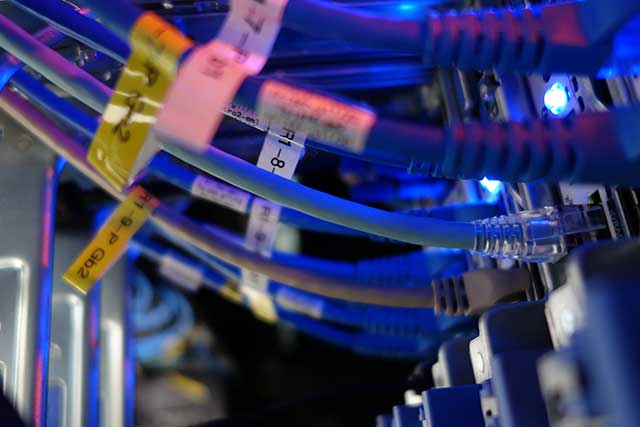
| Labeling and documentation | Labeling every cable run and recording each connection. | Gives IT staff a clear reference for network connections. |
| Cable certification | Verifying performance against the selected standard and identifying faults before equipment goes live. | Finds issues before the network is placed into service. |





Network Cabling and Cabling Planning for Connected Business Systems
Reliable business technology starts behind the walls. Well-planned network cabling gives computers, phones, wireless access points and building devices a dependable physical path for data, rather than asking every service to compete over an improvised connection. The right cabling plan considers today’s workstations and tomorrow’s expansion: desk locations, meeting rooms, equipment racks, ceiling-mounted Wi-Fi, printers, point-of-sale devices, security cameras and access control readers all need a clear route back to the network.
Cabling Planning Checklist
- Map desks, Wi-Fi points, cameras, phones, and access-control devices before installation.
- Select cable categories that support required speeds, file transfers, VoIP, and video traffic.
- Keep data cables separated from electrical lines to protect signal quality.
- Label every run and patch-panel port for faster troubleshooting and future changes.
- Reserve rack space and cable pathways for new devices and office expansions.
Network Cabling Planning Checklist
| Planning area | What to document or assess | Why it matters |
|---|---|---|
| Device locations | Map workstations, phones, meeting rooms, wireless access points, printers, point-of-sale devices, security cameras, access control readers and building devices. | Each connected device needs a clear path back to the network. |
| Cable routes | Plan routes from device locations to equipment racks, including ceiling-mounted Wi-Fi and pathways for later runs. | Clear routes support organized installation and reduce disruption during changes. |
| Cable category and run length | Review cable category and planned run length for each link. | These details affect signal quality and usable speed. |
| Patch-panel layout | Document the patch-panel arrangement and connections at the rack. | An organized layout makes connections easier to trace and manage. |
| Labeling | Record a labeling plan for cable runs and rack connections. | Labels make troubleshooting, repairs and later moves less disruptive. |
| Electrical separation | Check separation between data cables and electrical lines. | Separation affects signal quality and usable speed. |
| Rack capacity | Plan spare capacity at the equipment rack. | Space at the rack supports new devices as business needs grow. |
| Future expansion | Document spare pathways for future cable runs and expected device additions. | Future work can proceed without reopening finished walls. |
| Site survey and existing cabling | Survey the site, identify weak links and damaged runs, and note crowded cabinets or intermittent faults. | Targeted repair can address issues before they become daily interruptions. |